
I’m back home. I’m back in summer, back in my apartment, back to work concerns, and my ever-complicated social life. I’ve shaved my legs, done my laundry, and plucked everything that needed plucking. And everything is back to normal. But South America changed me, and I hope the change is lasting.
I spent a day in Santiago before my journey came to a close. It is a cosmopolitan city. Though Lima is as well, Santiago felt like a European city. I ate well and had wonderful coffee as I wondered the streets. With only a little time, I did some power sightseeing – Santa Lucia Hill and the estate at its summit; the large San Cristobal Hill with its virgin statue at its top (I took the funicular in this case); and the Soho of Santiago, the Barrio Bellavista, which had beautifully graffitied buildings and outstanding people watching.
Bellavista also claims the Santiago home of the poet and activist Pablo Neruda. I’m not a house tour girl, but it felt like a don’t miss this kind of place. He built the home as a secret love nest for the woman who would become his third, and most beloved, wife, Mathilda. It was a great. I only have a very cursory understanding of Chile’s recent politics and I learned about Neruda’s political life and even more interesting about the bravery of Mathilda following Neruda’s death in 1973. Mathilda redecorated the house following Neruda’s death (she had to, as Pinochet’s people had ransacked it) and her taste ran heavily towards 70s mod. I would move in tomorrow and not change a thing.
Thanks to Mark Zuckerberg and his social network, I learned an old colleague lives in Santiago now and I the last thing I did in South America was sit down with him for lunch and a couple of beers. It has been a month since I’ve seen a face that I knew before July and it was a great treat. He is someone I liked then and I like him more now. It also prepared me for conversations about things other than walking poles and canteens.
Happy and excited to come home, I headed for the airport. A few hours and an airplane snooze later I was in Brooklyn and then drinking beer in the East Village. Nothing had changed and everything had.
I am excited to soak in a little more summer – Tanglewood here I come – and to welcome the fall. I’m looking forward to a heavy work scheduled and to seeing my friends in the US.
But I’m really looking forward to the next trip. What should it be?
It took a long time to get to Puerto Iguazu and I the entire journey I was thinking I’d made a terrible mistake in trying to jam it into a trip where it clearly didn’t fit. I’d had a terrific trip so far and I was tired, homesick an not enjoying the ride anymore.
I arrived mid-day and after sorting out my flight troubles, I was had to make a decision, sleep was clearly the wiser, after 30 hours of travel with basically no sleep, and what I had planned on doing with my afternoon when I still thought I had monday in Iguazu. But I opted for the jungle tour instead, which as I mentioned yesterday, solidified my realization that I don’t like the jungle.
When I awoke the next day, my jungle furor was reinforced, the bugs I knew had been attaching me whilst there had left their marks all over my ankles and lower legs. I later found out that I was not, as I’d assumed, covered in mosquito bites, but in tsetse fly bites. Yes, the tsetse fly – carrier of African sleeping sickness (which would kind of be awesome to get).
I also learned to trust my cell phone. I was confused with times and time zones and in my hubris, decided the time I thought it was, wanted it to be, was correct. It was not. And I would have been far later than I was for my shuttle to the Falls if some kind desk clerk hadn’t called me.
But I made the shuttle and on we went. Also on my shuttle were American couple, Kim and Steve, who have lived on their boat traveling the world since 2009; and a Alexandra, a Peruvian living in Buenos Aires and her mother, visiting from Lima; a middle-aged, very computer nerd looking couple from London; and Hank, a Dutchman traveling alone. We chatted our way to the Iguazu park and on the very Disney like train that brings one from the gate to the path and then fell silent as we walked the wooden paths over the water towards the falls.
I cannot convey them to you with words (the photos are on Facebook). We came first to the Devil’s throat, where several falls converge. The power of the water was immense. I had to stop myself from taking pictures and just breathe in the image for a moment.
Iguazu is a series of waterfalls on land in Argentina, Brazil and Paraguay. I was only on the Argentina side, but it was staggering. You walk through the acres of the park and some falls are delicate and precise, some are massive and powerful. One particularly lush corner holds the two sisters, side by side falls that are so photogenic that they are the prevailing image from the film The Mission.
About halfway though our tour, Alexandra, her mom, Hank and I split off to go take a boat tour. I signed up thinking it would be like Niagara’s Maid of the Mist, which I admit to not knowing anything about, but I assume it’s a gentle ride during which you can take photos. Our ride, during which we were joined by a high school group from Spain, was a thrill ride, which featured the motorboat zooming close the falls for maximum wetness. We got soaked, and laughed a lot, but I’d just as soon keep walking along the park.
We walked further in the afternoon, after a quick hamburger, which amusingly was a burger with ham on top, and a run-in with the local wildlife. In the afternoon light, the falls projected bright ever-present rainbows. It was magic.
I went back to the hotel overwhelmed by the beauty of Iguazu and convinced of the wisdom of my decision to visit.
I have a strong constitution, in general, and a high tolerance for inconvenience, but the past 36 hours pushed me almost over the edge. Admittedly, planning my most taxing travel day at the end of a four-week journey may not have been my wisest move, but still.
I left Torres del Paine at 7am yesterday. Though some guests had arrived the night before, none were going on morning excursions, so I was particularly moved to see many of the guides and gauchos there to give me hugs and see me off. Christian loaded my backpacks in the van and we began the four-hour drive south. I’ve seem more spectacular sunrises this month than I have in the past 5 years or more, but I still made Christian stop along the way so I could grab some shots of one last one (turns out the one I would see from the Buenos Aires airport was pretty great too). Eventually, when he knew a great sight was approaching, Christian would pantomime taking a photo, so I’d be ready, and then slow the car to nearly stopped. I used up a battery on my final images of the park and the drive.
At Punte Arenas, Christian, who I’d just met that morning, gave me one final hug and I was off. The trip from Punte Arenas to Santiago was uneventful and easy, but I knew what lie ahead. I landed about 7, and my flight to Buenos Aires wasn’t until 2:30 am. Yup. AM. I’d been advised against trying to shoot into town for dinner and after some pleading and puppy-dog eyes, the check in attendants took my big bag and I headed to the gate for bag quiche, good beer, and several hours of Game of Thrones which I’d downloaded specifically for this day (OMG – why didn’t anyone tell me about this show!)
It was a long haul, and I didn’t sleep at all despite great efforts (I’m not a good public sleeper), but 2:30 cam and we were Argentina-bound. By six I was wheeling my luggage through the BA airport and trying with all my might not to give voice to the lyrics from Buenos Aires rolling through my head. A couple times I couldn’t help myself – Stand back, Buenos Aires, you don’t what you’re gonna get in me! Just a little touch of star quality!
THe trick became the next flight – 9:20 to Puerto Iguazu Falls, but it was from a different airport. It really was the equivalent of flying into Kennedy and out again from LaGuardia, but until I was on, then off, the shuttle between them, I was crossing my finger, and had moved on to the Rainbow Tour in my head – Let’s hear it for the rainbow tour, its been an incredible success. Or not.
And finally, more than 24 hours from leaving Explora, I was on the final leg of my journey. I’d be met in Puerto Iguazu by a driver. I may even have slept a bit on the plane. He was right there, holding a sign with my name on it as I exited the airport and the first words out of his mouth were “I have bad news.”
My Monday flight back to Buenos Aires, scheduled to give me maximum time at the falls as well as relaxation time, had been cancelled and I could either take a late flight on Monday, missing my connection to Santiago that evening or a very early one leaving me again with a long layover. I couldn’t stop the tears and I let them come, but then gathered my senses, consulted with a counter attendant and got myself back to BA and then on a much earlier flight to Santiago, so what would have been a rushed tour of BA and a rushed one of Santiago actually left me with quality time in the Chilean capital. Don’t cry for me Argentina, I’ll be back to see your capital another time.
That sorted, we headed to the hotel. This afternoon was going to be rest and a walk downtown for me, but with one less day, I signed up to see the Iguazu jungle. I have now given it sufficient research and jungles are not for me. They are hot and buggy and the flora is not what the New England forests provide, but rather harsh and lacking beauty for me (I”m sure there are many or disagree with me). Should I find myself musing over another trip and I mention there’s a jungle involved, please remind me I don’t like them.
We hiked a bit, I was the only American among visitors from Buenos Aires, so as instructions and cautions were yelled out in spanish, I just hoped for the best. At a cliff site, we donned harness and repelled down. I rock climbed once in New Hampshire, but I liked the down and I did again. It was less than a minute to the bottom, but great fun and though we felt very brave, completely safe.
We headed deeper into the woods and were warned to no longer take photos. The Argentine army patrolled these grounds and did not allow photography. Indeed everywhere there were dark-eyed, olive-skinned men in fatigues and tight green t-shirts which showed impressive abs, clutching very large rifles.
Next up was the zip line. A three-part course, that we were warned, only allowed you to change your mind about taking it on the first part. If you decided to try and hated it, there was no going back. I’ve never done a zip line, but I like going fast, don’t have a fear of heights, and will try pretty much anything. You move quickly over the trees, from one platform to the next, with a quick movement to slow down so as not to crash into the rest stations. It was fun, but not something I need to do again.
And with that the forest tour, such as it was, was complete. The residents of the park are all tribesmen who have lived there for centuries. We stopped at a local farm selling handicrafts, and while I was tempted by a blow gun, I left empty-handed.
Tomorrow is the day! I will see Iguazu. I have wanted to go to Niagara Falls for a decade or more and still haven’t made it. That’s a big part of why I went to the inconvenience of getting here. I”m told its like ten Niagara Falls. I just need the one and I can’t wait!
But first – SLEEP.
As I planned this adventure, I wanted the intensity of Peru and the group travel thing followed by a little bit of splurge and pampering. And I’ve come all this way, so I wanted to catch a bit more of South America. It took a lot of maneuvering to decide what to fit in for what I’d determined could be no more than a 4 week trip. I had a romantic notion of visiting the absolute tip of the Americas – Tierra Del Fuego, and maybe even hopping a boat to Antartica. The fabulous, writer Simon Winchester had some thoughts for me, but ultimately his idea of adventure is way more adventurous than mine (my idea of adventure is like Simon’s sunday afternoon).
Anyway, I loved the idea of Patagonia. After all, I already had the jacket. I kind of cheated by finding Explora, a luxury adventure travel group with three locations in Chile. Its not so rugged really, there’s wine and delicately prepared foods, but you are plopped in the middle of a rugged, remote landscape, now the Torres del Paine national park, nearly 1000 sq miles of glaciers, lakes, rivers, forests, and pampas, and expected to interact with said landscape every day.
Its winter in Patagonia and I was very warned against coming this time of year for fear that I’d be walking into a frozen nether land. With thanks (and disdain) towards global warming the weather was never worse than a late fall day in Maine. You’d need a down jacket, maybe gloves if you weren’t moving too much, but invigorating and sure to deliver a proper rosy-cheeked glow.
Many other folks did heed the warnings to find a different time of year, and the Explora hotel is the only one open this time of year. Yet it was still nearly empty. My first night there were less than a dozen guests. By my third, it was me, Nick from Sydney, Stephen from Christ-Church, and Sven from somewhere in Poland. We formed an odd family and gathered for cocktails at the bar each evening to share stories of our days.
Explora offers excursions into the park ranging from extreme – conquering the glaciers – to very mild – a leisurely walk around the hotels gorgeous grounds. Each evening we’d meet with a team of guides to plan our next day’s activities. The guides, along with the rest of the staff, lived at the hotel year round (it’s too far from anywhere to commute) and have been known to “go mad” during the winter months according to gossip they were happy to share. I knew these guides well, they are like so many 20-somethings I’ve known in New England, in fact until recently, they had a guide from Vermont, but he moved on to the Alaskan wilderness. The women were all clear-skinned, bright-eyed and wore braids. The guys were all a bit shaggy. with odd patches of facial hair, tattoos, or piercings. But all were extremely well-trained, charming, and fun. I asked what happened if they didn’t like someone they were guiding and all swore that it had never happened
I had two guides during my six excursions. The beautiful Camila, a former model and chef from Santiago, and David, a local kid who was raised with the park as his playground. Both were great company.
Camila took me to a nearby lake on my first day out, where we marveled at the geological formations and talked about life and boyfriends. Males outnumber females by a lot at Explore, both on the staff and guest sides but her dating pool was a little small still. After three years of guiding, she wasn’t ready to move on, but she said she may be soon. Her father’s advice, when she came south for a six-month internship in a kitchen in Patagonia – “don’t fall in love with it.” He knew if she did, she’d never leave. And he was right.
Its had not to fall in love. The landscape is stunning. You can close your eyes and spin and when you open them again, you’ll be looking at something fabulous. During my excursions, I saw icebergs, geological phenomena, ancient cave paintings, as well as imposing glaciers and mountains. The landscape was riddled with guanacos, a kind of wild llama, and sometimes with the remains of a guanaco who’d met a bad end in an encounter with the area’s pumas (I never saw one). Also on hand were bunnies, foxes, condors, beautifully colored birds, condors circling over head, and bright pink flamingos. The fauna was sparse because of the season, but the forest was lush with evergreens and the pampas were dotted with trees and grasses. The winds are strong in Patagonia, so the tress grow up and into the winds in such a way that it always looks gusty even if the air is completely still. Yellow pom poms that could have been drawn by Dr. Seuss dot the trees. They are a parasite and dangerous to the tree, but they look great.
In 2011, a wildfire, ignited by a backpacker burning his tp, devastated the park. With high winds and dry lands the damage and danger spread quickly. Listening to the staff talk about evacuating that day is like listening to New Yorkers recall September 11th. The shock, fear, confusion, and sadness felt so familiar. Charred trees are everywhere. A terrible reminder that the biggest threat in the wilderness is us.
When I wasn’t hiking, I was riding. The Explora stables are run by Patagonia gauchos. They took me out to the Lago Toro to test my limited skills and then up a steep mountain to look over the park from above. After the ride, the gauchos and various guides who were around invited me into their small kitchen to warm up with some mate tea. The gaucho ritual of the tea was detailed but charming and, like tea ceremonies worldwide, ultimately designed to bring us all together as a community. The mate itself was strong and bitter, but I had three cups.
5 days flew by, perhaps the best vacation of my life. I may have cheated a bit in my experience of Patagonia, but I loved it. I may even have fallen in love with it.
My flight to Santiago was long-delayed. (so were the flights to the UK as Richard informed me when he popped over to my gate, bored of sitting at his). I finally arrived in Santiago close to midnight and went through the long process of customs. First you have to pay a tax to get into the country, then a very long line (though the airport did smell like ginger, which was quite great), then you must have your luggage x-rayed on the way out. FInally, I was in a cab to the airport Hilton and before I knew it, I was in a cab back to the airport in the morning.
A pretty painless flight, with a first class upgrade (though the plane was undoubtably too old – it still had ashtrays), to Punto Arenas, and I was met by a driver from Explora, the folks in charge of my stay in Patagonia.
He loaded me in his car and started off, quickly putting and end to my small talk by saying he didn’t speak English. We drove out of the city quickly and onto a long empty road. Nothing but wide open fields on either side, sometimes dotted with sheep or cattle, and a huge sky. After about an hour of driving, I spotted a sign post indicating it was 225 kilometers to Torres del Paine, my destination. Wait – 225? why didn’t I just fly there. That was still 2 more hours of driving in silence away.
A little further on, there was a small inn, that looked a bit like a wild west tavern and we pulled in. The inside was as quant as the outside with wagon wheels and photos of old gauchos on the walls. This is where we toilet and get a sandwich my driver told me. So I toileted and got a steak and avocado sandwich (yum). He pointed to a table for me to sit and eat and he headed to the bar to talk to the waiter. When I was done, he signed a bill and said come on as I tried to offer money.
We drove into the hills, passing graffiti covered rocks along the side of the road. The graffiti here is catholic, proclaiming Dios and Jesus the Amo.
I could see the mountains and glaciers in the distance and then getting closer and closer as it got darker. There were strange prehistoric looking trees and wiry bushes with big Seuss like yellow pom pom flowers.
And one we drove, never seeing a person, car, or building. Slowly I began to wonder if we’d ever get there, of if I had entered a Stephen King novel. And not one of the good ones, one of the ones where weary travelers trust the kindness of strangers and end up as dinner. I realized that if he’d wanted to kill me he’s succeed, there was nowhere to run. But I was comforted in the fact that he probably could have done it far sooner and saved some time and there was no reason for an avocado sandwich first, so I resigned myself to whatever fate had in store.
Another hour of driving and tiny lights appeared on the horizon. As we got closer, I saw the outline of a building and finally we were there.
I got out of the car into heavy winds as a woman ran out of the building to great me.
Welcome to Explora, she said. And I was here.
Our last day together as a group. We woke early and met in the lobby for a morning tour of Lima. Our guide for the day was a woman – the first one on this trip (or the last for that matter). I hadn’t noticed until she was standing there and then I was so pleased to see her.
Paula was from Araquipa, in southern Peru, a town that we did not see, but everyone we met who had been there insisted that we should go (next visit). She had come to Lima for the same reason everyone does, she told us, for a better life.
Lima has nearly the population of New York and has a bustling urban heartbeat. It was founded by the Spanish conquistador Francisco Pizarro, who’s head was later displayed in the main square. Our final day there was the 27th. On the 28th, Peru would celebrate its Independence Day, the day it was liberated from Spanish rule. In Peru it is a law that every house and building display the Peruvian flag on Independence day, so the city was awash in red and white fabric.
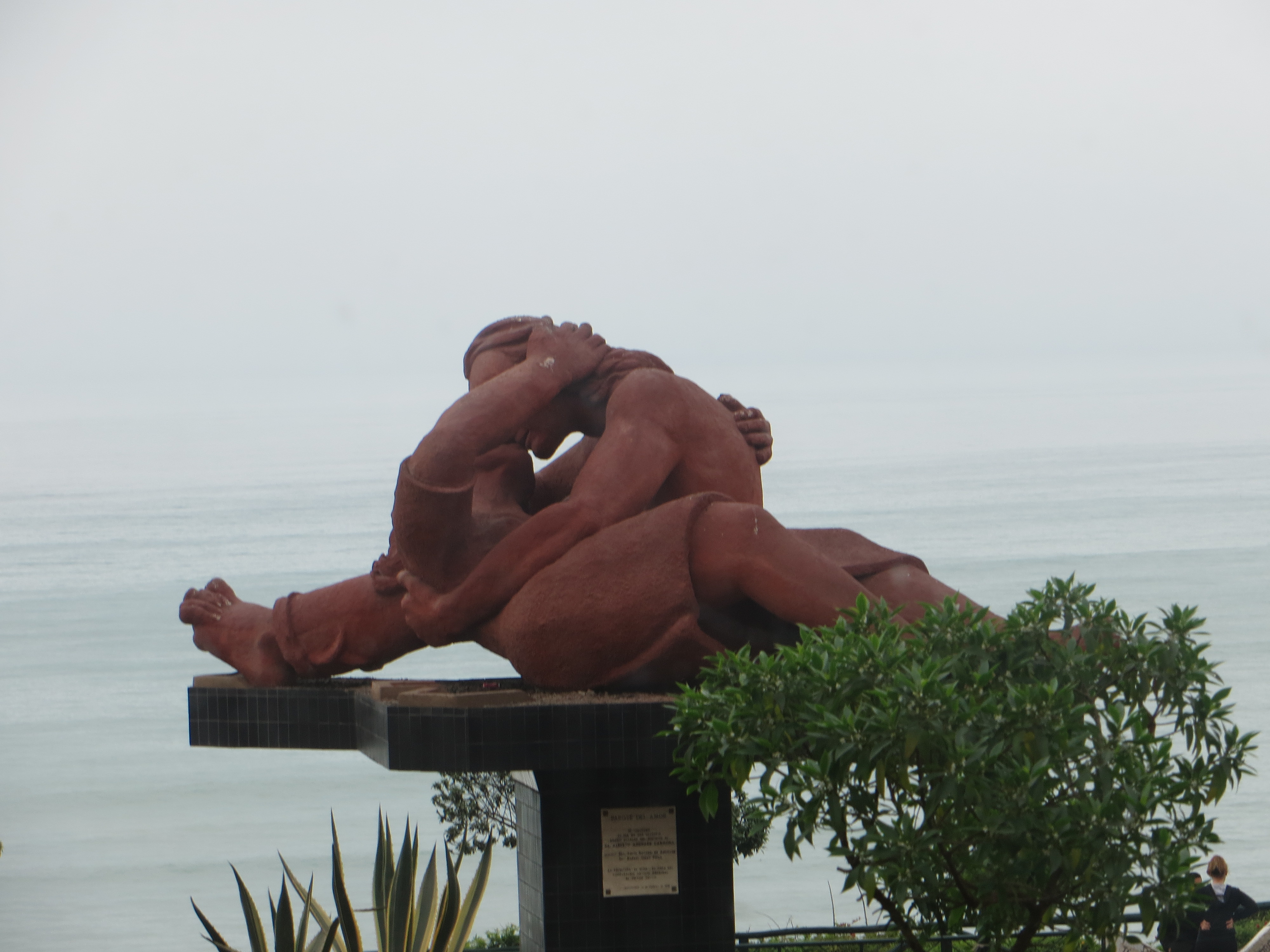
We drove along the coast for a while on a new highway that had been created by blasting out what was just recently cliffs down to the water. Along the way we passed a park dubbed Love park, which was inaugurated with a kissing contest and and featured a giant statue of couple mid-embrace. A pretty hot embrace at that.
Since many streets were closed in preparation of the next day’s festivities, we got as close as we could to the Monastery of San Francisco, before having to park the van and walk the rest of the way. The monastery was beautiful in that old catholic church way, cloisters and mosaics and old paintings of saints. There was a large rendition of The Last Supper in what would have been the nuns dining room. There are a lot of Last Supper variations in Peru and this was typical of them. There was Jesus and the disciples, but there were lots of visitors and depictions of the the friends of the artist or patron. Also, the meal was depicted as a Peruvian celebration, highlighted but the main course, guinea pig. Seriously. They’ve all got Jesus eating a guinea pig.
THe main attraction at the monastery is the catacomb. Down beneath the building there are the remains of thousands of people, all nicely displayed by body part – femurs here, skulls there. While we were down there, Paula talked to us about the seismic activity in Lima. Um, could we not talk about earthquakes while we’re underground?
We walked to the main square where preparations were underway for the celebration. News crews were practicing camera angles, gardeners were hard at work, and police in riot gear were every where. Its a lovely main square, but the whole thing felt like a scene from a movie about a South American dictatorship. I was happy to move on.
We left Paula at a shopping center along the shore and headed to yet another fabulous Juan suggested restaurant where we gorged on ceviche and dulce de leche and pisco sours until it was time to go to the airport.
Hugs all around, emails exchanged, an promises to keep in touch vowed, we went to our gates. Adios Peru. I loved you!
I first heard of the Lake Titicaca in my high school chorus room. It was part of the Ernst Toch’s Geographical Fugue and we had to learn it. I learned a lot of geography from that song. I still sing it (in my head only, not to worry) when I hear the name of the big lake. That’s different from many reactions, which is mostly snickering. Turns out even in Peru, the snicker a the name.
We stayed in the lovely lakeside town of Puno, at the most luxurious of our hotels for the trip. A late start added to both the luxury and the realization that we were nearing the end of our journey. Gathered in the hotel lobby, Juan and Joseph, our local guide led us out to our “transportation” to the Lake. Tuk tuks. We jumped in pairs, Graham and me together in one, and headed down the long hill to the lake. Our peddler was speedy and the seemingly unregulated traffic and constant speed bumps made it an exhilarating, but terrifying, ride. We stalked up on water and snacks from the vendors lining the shore and headed to our boat.
The marina boats are lined up along the dock pin such a way that you have to walk over one boat to get to the next. Ours was five boats in and the risk of falling into the very cold water was ever-present as we made our way over.
All safely in place we headed into the Lake. Its deceptive. At first it looks like an average large lake. We slowly passed by reeds and into more open waters, when it became clear that this was indeed no ordinary body of water. On some horizons the Andes were visible far in the distance, on others there was nothing but water, as though we were out in the sea.
Our first stop was a visit to the Uros Indian community who live on artificial floating islands made of reeds. In the 1800s, the community lived on shore, but rejecting the Spanish demands for taxes, they moved onto the water constructing islands of soil about 2 feet deep, which floats like a cork, covered with reeds. Every 6 years of so they have to rebuild their islands. Blocks of the soil are roped together to form small communities. THe one we visited had a couple of brothers, their wives and children living on it. Should one decide they no longer want to live there, they just unrope themselves and tie to another community.
The villagers showed us how they built the island with an amusing pantomime, and periodic translation from Joseph. They showed us their meals of fish and duck (with a dead duck as a prop) and then invited us to tour the small island. One of the women approached me immediately saying amiga and gesturing for me to come with her. I grabbed Claire and we followed her into a small hut with a tiny bed made out of straw. She told us (mostly in sign language) how cold it was at night and how she lives with her husband, bambino, and a cat in the tiny room. Then she invited us to buy some of her handicrafts. Tourism is big business for the Uros and while we were in the hut, little displays of wares (tapestries, necklaces, straw sculptures) had popped up outside. The Uros had initially created the islands to escape modern society, we embracing it whole heartedly – each one-roomed thatched hut had a solar panel out front and a laptop inside thanks to the efforts with international tourists.
Asking about the lifestyle, Joseph admitted that most of the Uros teenagers lived on shore where they could go to school and have a broader social life. But, like the Amish on Rumspringa, most ultimately return to the islands to marry and perpetuate the community.
From the small island we boarded a boat made out of reeds and were rowed by the two brothers to a larger island featuring a gift shop, grocery, and bar. Joseph brought our bigger boat over and after dropping a few solas each, we waved goodbye to our hosts and headed out deeper into the lake..
For two hours we slowly cruised the Lake. I sat in the back of the boat, feeling the spray and enjoying the sun and water (I was heavily sun-screened).
We docked alongside many tourists boats on Tequile Island. The Island has about 2000 inhabitants and specializes in farming, textiles, and tourism. We were greeted by large signs asking us not to give the children of the island candy or to take their photos. The Island is shaped like one of the Hawaiian Islands, and everything happens at the top, so we climbed. About halfway up, we stopped for lunch on a restaurant terrace overlooking the lake and, in the distance, could see Bolivia’s glaciers. We were treated to the trout from the lake, our favorite beer, Cusquenia, and a mint tea, with mint twigs pulled from the ground around us, floating in hot water.
Fortified, we headed the rest of the way up the Island towards music playing in the distance. We arrived in the town square as they were in the middle of a festival. It was an annual event, to celebrate what I don’t know, and we happened to be there on the right day. Hundreds of men, women and children were gathered in brightly colored outfits dancing in the square. One man was offering sips out of his water bottle to the dancers – Joseph told us it was a kind of homemade booze, which I’m guessing tasted like firewater.
We danced along with them for a while, perused the textiles on sale (I come close to spending way too much money on a scarf, but didn’t) and then began the long walk down to our boat.
On the way home, the entire group gathered to play Graham’s card game, Shithead. It passed the time quickly and many laughs were had – though poor Richard lost more than his share of games.
That night we headed out to a local dinner theater type place. Puno is famous for its dancing and dancers and the stage featured a panpipe band (pretty ubiquitous here) and several groups of folk dancers. It was a bit cringe-worthy alongside being completely fantastic. It is also the moment that we all tried the Peru specialty fried guinea pig. It was a small portion for 7 people, leaving Juan with the head, but we each took a turn. You can fry anything and it becomes edible. In this case, it tasted a bit like roast duck. In fact with a pancake and plum sauce, I would have told you it was roast duck.
The following morning, we rose late, went for lunch at a local empanadas joint (2 empanadas and a coffee for $3), and boarded a bus to the Juliaca airport.
Along the way we stopped at an Incan burial site, on the top of yet another hill – the Incans liked to be high up, they believed it made them closer to god. The number of tourists climbing up crying “bloody hell” might have made them change their minds. The site was another marvel of Incan design. Large conical buildings acted as mausoleums for the dead. One structure was mid-way through construction when the Incans fled the Spanish and the ramp on which they pushed the boulders, as well as a pile of stones meant to be added, we still in place. Oh, how I wanted to climb that ramp, but, as apparently others wanted to as well, there was a big sign saying something in Spanish loosely translating to Don’t you dare climb this ramp.
At the Juliaca airport we waited for our flight to Lima for our final day and played a bit more Shithead.
We decided two decks of cards would make the game more interesting so we combined my deck of Pope John Paul II cards, purchased at the Vatican, with Claire’s deck of Incans from Cusco. In the case of a show down between the same card we decided that, as in history, the Christian card would trump the Incan.
It was nearly midnight when we got to our hotel in Lima. There was a movement to go out for a final pisco sour, but I headed to my room. THe morning held a final tour of Lima, then flights for all of us, so we were all a bit wistful, and joyous at the same time.
I did love that Lake!
After a spectacular visit to Machu Picchu, we took the train back to Cusco to gather our belongings we’d left behind and get a quick sleep in before an early morning drive across the Altiplano (the high plains), to Lake TIticaca (go ahead, laugh. Get it out).
As we left the town of Cusco, though we were still in the Cusco region, we passed through a number of small towns, each with its own gastronomic specialty. Peru is highly rated for its cuisine (considered among the best in the world) and Juan is a foodie of the first order – his wife is also a restaurateur. It is a quirk of Peru that each town does its own thing, but that is how it works. For one its guinea pig, the next chicken, then duck, beef, there’s even a town devoted to bread. If you want duck, don’t go to guinea pig town and expect to get it. As we drove further, town specialties became less about food. One town made roofing tiles, then next little ceramic bulls. We stopped to look at a few more Incan ruins and then forged forward on the 8 hour drive across the plains.
They are dull. Wide fields sometimes with sheep or llamas, surrounded by mountains. Everything is a kind of straw yellow color. THe scenery never really changed.
What was significant though were the mountains. Yellow with specks of green, they were once all somewhere between snow-capped and snow-covered. And not that long ago. In some cases only a decade had passed since the desolate peaks had been glaciers. You hear about global warming, and certainly the weather has been weird, but folks in these mountains are watching it happen right in front of them. It is shocking to see.
We crossed the Continental Divide separating the east and west mountains and eventually came to civilization again. Such as it was. We entered the town of Juliaca in the Puno region. Juliaca is a wild west town, known for its smugglers (its close to the Bolivian border and things are much cheaper there), its knock off jewelry, and its tendency towards alcoholism and violence against women. We were all happy to pass through and out-of-town.
I’ve spent my life visiting New Hampshire’s Lake Winnipesaukee. As you come off the highway, there is a round-about which, halfway round, reveals the first site of the lake. We had a game in my family to shout “I see the lake” as soon as you did. To this day, if I don’t say it out loud, I definitely still think it, as I go around that bend.
That’s what it felt like as we entered the town of Puno and there she was, Lake Titicaca.
We arrived at our hotel in time for dinner in town (another wonderful meal, capped with pisco sours at a Juan suggested restaurant), and then off to bed. The next day was the day I’d been looking forward to the entire trip – our day on the Lake.
I wrote the last post so quickly (Juan successfully fixed my charger and the computer is back in action), that I wanted to tell you a bit more about our hike.
It happened over four days and three nights. We were warned that the temperatures could change wildly, and we felt prepared. Graham and I were led by our guide Roberto and joined by a cook, Modesto, and two horsemen with three horses among them (one of which spent a lot of time with me on him).
One thing you realize quickly on this kind of trip is that things never go as planned. The trail we were taking is a beautiful hike though many types of Andean terrain. But the road to the trail was under construction, so the first couple hours of our hike was along a dusty road populated with coverall-clad and face-masked workers and earth moving machines. About halfway to the trailhead we passed our horsemen, coming from a village on the mountain. They had to head back where we’d left the truck to pick up our a backpacks and then double back to meet us on the path. (This, of course, was no problem for the hearty fellows.)
The trail, when we reached the start, was beautiful and lush, lined with tiny blue flowers, with sheep dotting the hillsides. As we got higher the vegetation would change, of course, but it was a beautiful start to our journey – albeit a late one. The horsemen and their handlers quickly joined us and after a few hours of climbing we stopped for lunch. Our lunch spot featured one of the many Incan ruins we’d pass along the way. Like the ruins in Rome, they’re just there – you’ll be walking along and there will be the familiar stone work or terraced slope that marks the Incan design. Incans didn’t use cement or any sealant as they built their marvels. They would cut each stone to fit together like a jigsaw puzzle, keeping a bit of space to account for cold or hot expansion or compression as well as earthquake activity. When the Spanish conquered Peru, the tore down many Incan buildings or built over them. Earthquakes have claimed many of their buildings leaving the Incan sites alone. (and yet, they couldn’t figure out the wheel).
During lunch, Roberto became concerned about my cough and had a special coca tea made for me. It was really just coca tea with a lot of lemon, but it felt great. Coca is the trekker’s secret weapon. It is a leaf plentiful in the Andes and the root for one of Peru’s biggest exports – cocaine. But as a leaf it makes a wonderful light tea. Trekkers are encouraged to chew it as well, to fight altitude issues. I didn’t, but maybe I should have.
As we climbed on, and eventually I rode on, the terrain changed. Trees fell away and were replaced by yellow grasses. Our late start got us to our first camp site just before night fall. The horsemen’s were from a nearby village and their children, who will likely follow in their footsteps, came to help set up our camp. It’s a tough fate to be a born in the Andes. There are few primary schools and they require long walks for most students. If a child wants to go on to secondary school, the child has to move to a bigger community lower down, either in with relatives or the entire family must move. University is usually not an option, but that requires even further moving. Most Andeans are Quechua and don’t speak Spanish, so they are further hindered in city life.
Our camp consisted of three sleeping tents – one each for me, Graham, and Roberto ; a toilet tent with a seat like a child’s training toilet and a little bag of limestone to dissolve anything unpleasant; and a dining tent where the tree of us would take our meals. I’m not sure where the other guys slept and I’m not sure they wanted us to know. The horses just wandered freely but never strayed too far.
Meals on a trek are a treat. I learned this on my last trek, but it was reinforced on this one. I, however, was unable to appreciate the fabulousness, not to mention work, of the meals. I suffered from what is a common problem in altitude, a complete loss of appetite. Feeling sick and weak, I went to bed soon after dinner, followed closely by Graham and Roberto.
Our first night on the mountain was cold. Not as cold as our second night, but by then we were prepared for it. The sky was clear and the moon was bright enough to make headlamps unnecessary. We all used the toilet tent and snuggled in our sleeping bags hoping against hope we wouldn’t need another visit before morning.
I’m terrible at sleeping in sleeping bags. I’m a toss and turner, so by morning, I always end up a bit mummified.
Day two was our hardest day of climbing and we struggled up a steep, sandy ridge. After a couple of hours of hiking, the horse approached and, given the option to ride, I didn’t’ refuse. After lunch, Graham pointed out that it looked like it might rain. As he said it the hail began. About the size of the pellets in a bean bag chair, the hail followed us into camp. Between tea and dinner that night Graham taught me a great card game with a slightly obscene name, that became our constant pastime.
Day three was a lot of down. Steep, steep down in loose red sand. I landed on my bottom as often as I didn’t, sure-footed I am not, and got to camp a dusty mess. After some tea, Roberto suggested I wash my face. Looking into the closest thing I had to a mirror – my sunglasses – I could see that I looked like on of the Little Rascals, covered in dirt.
Day four, we triumphantly hiked into Ollyantetambo in the Incan Sacred Valley and straight to a bar. By this time, Graham had a sprained ankle and my burned lips were torturing me. But we were thrilled with our week.
It was a hard slog, but so worth it in the end. And of course, there was still Machu Picchu.
Lots of people have lots of opinions about me. I really only care about the good ones (and I do consider teasing a good thing. I can take my faults presented in a loving and humorous manner – god knows I have enough of them.) I think that most of the people that love me would describe me in two, seemingly contradictory ways. I am very, very self suffiecien in my life, but sometimesits amazing I can get through a day without a lot of help with the most basic of tatsks or decisions. Usually, these are of the most every day variety – how to cook rice or where to get a phone charger. The theme of this post is all the help I had along the way this week and how much I appreciate it.
We got an early start on trek day – Graham and I heading off with Roberto for the Moonstone Trek, the rest of the group heading with Juan to the Inca Trail. The Inca Trail allows only 500 hikers to start each day and Graham and I booked late enough that we weren’t able to get permits. The moonstone trek is one of the hundreds of other Inca trails but is not well known. In fact, aside from a few Andeans who lived in the mountains, we never saw another human until our last night.
Before we got to the trail head, we stopped for supplies and at a local town festival (there is always a festival somewhere in Peru). The boys in Fire Island would love Cusco, whose flag is the rainbow. We couldn’t believe it when we saw a church festooned with the flag, such pride, which is when Roberto explained it to us and said many westerners made the same mistake. Some women outside the church in the traditional Andean skirts, hats and braids offered us the most delicious tea made from coca seeds, cinnamon, cloves and a lot of milk. Fortified, we drove on – stopped at the actual Moonstone – an Inca carved boulder, and headed on to the trail.
What is a slight cold at sea level becomes a constant, hacking torture in altitude and very quickly I was down for the count. Still, we soldiered on and up and another couple hours, Graham running ahead, me coughing my heart out every few steps. At lunch Roberto came over to me and said, you are very strong – very good walker. A lie of course, but I thanked him. Also – you are a very beautiful woman. OK – I’ll take that one. As I thanked him for that he said, I think you should ride the horse. I started to protest, but really, who am I kidding – a free ride up the hardest part of the day, I”m in. I ended up on the horse for the better part of three days, but also hiked several hours each day as well.
Make no mistake, a horse in the Andes is not a trail ride. We went up steep passes on narrow, narrow paths, my heavy backpack wreaking havoc with my balance. The horse was led by our cook Modesto, who was good natured and smiley but spoke only Quequa, a local dialect that did not resemble my meager spanish.
Peru has two seasons, dry and rainy. Also – because of its proximity to the equator, daylight is from 6 to 6 every day of the year. Its dry season now, but the weather can turn o a dime and we went from t-shirts to hats and mittens and back several times a day. Nights were cold. Very cold. Graham taught me to fill my water bottles with our hot tea water before bed and use them to warm the sleeping bags (I had two because Juan brought me one from home knowing I’d be unprepared). Each morning and evening we were brought a bowl of ague caliente – hot water – to wash. On the second morning, my agua from the night before was a frozen block of ice.
On our second morning, not a minute out of camp Graham took a misstep and sprained his ankle. The stream nearby offered ice and I offered up my horse, but he limped on.
We played cards at night until we were too cold to go on and went to our tents praying we wouldn’t have to visit the loo in the night.
As we descended on the 4th day, the trail turned into a quarry. The Incans were an interesting bunch. They never invented the wheel, but managed to build architectural wonders. At one stop, we were invited to climb into the quarry mine, but went just far enough to see Incan skeletal remains.
Finally reaching town, Ollyantetambo, in the Sacred Valley, we celebrated with beers and the lunch Modesto had packed for us while waiting for our train the final hour to the small town at the foot of Machu Picchu. It was there that I realized my burned my lips were. devastatingly burned actually. I picked up some lip balm and applied liberally. With my white crapped lips and Graham’s limp, we were quite a pair.
Roberto left us at the train station, Juan would pick us up at the other end. It reminded me of the childhood visits between my divorced parents. For a few minutes (90) Graham and I were on our own. But Juan was waiting for us. We learned that despite our hardships, we fared at least as well and possibly better than the other group who had an infected toe, stomach issues and a drop out.
Still – we were back together. Maggie, seeing my lips, immediately took the balm I was using away from me and gave me something that actually worked.
We rose early to get a bus up to Machu Picchu. A hike up to see it from above was staggering. The so-called lost city lived up to its name. Clouds would roll in and cover it altogether. Then it would appear out of nowhere. I am reading Turn Right a Machu Picchu, which I recommend to everyone, about the discovery of the site in 1911 by Hiram Bingham, the inspiration for Indiana Jones. You could see him everywhere – the window which created a beam of sun at sunrise on the solstice, the sundial. How they did it without a wheel is beyond comprehension. It is a site that must be seen.
We broke apart and I headed to the hot springs in town. There I sat and looked at the impressive mountains before chatting with a couple of musicians in Peru to film a documentary. We talked about our shared love of music and travel. I love what they’re doing and am thrilled to have learned about it, especially in the hot tub.
Today we drove to Lake Titicaca. My charger has broker and Juan swears he can fix it, but if he cannot, it will be a few days before the next post.
 Mountains and Moxie